Deepfake Fraud Is Coming for Your Bank: How AI Scams Work in 2026 — and How Banks, Insurers and Customers Can Fight Back
A cloned voice and a fake WhatsApp message cost an Italian bank €95 million. How deepfake and AI voice scams work in 2026, why traditional defences fail, what regulators expect, and practical playbooks for banks, insurers, companies and families.
By Pavan Kumar Verma · · 9 min read
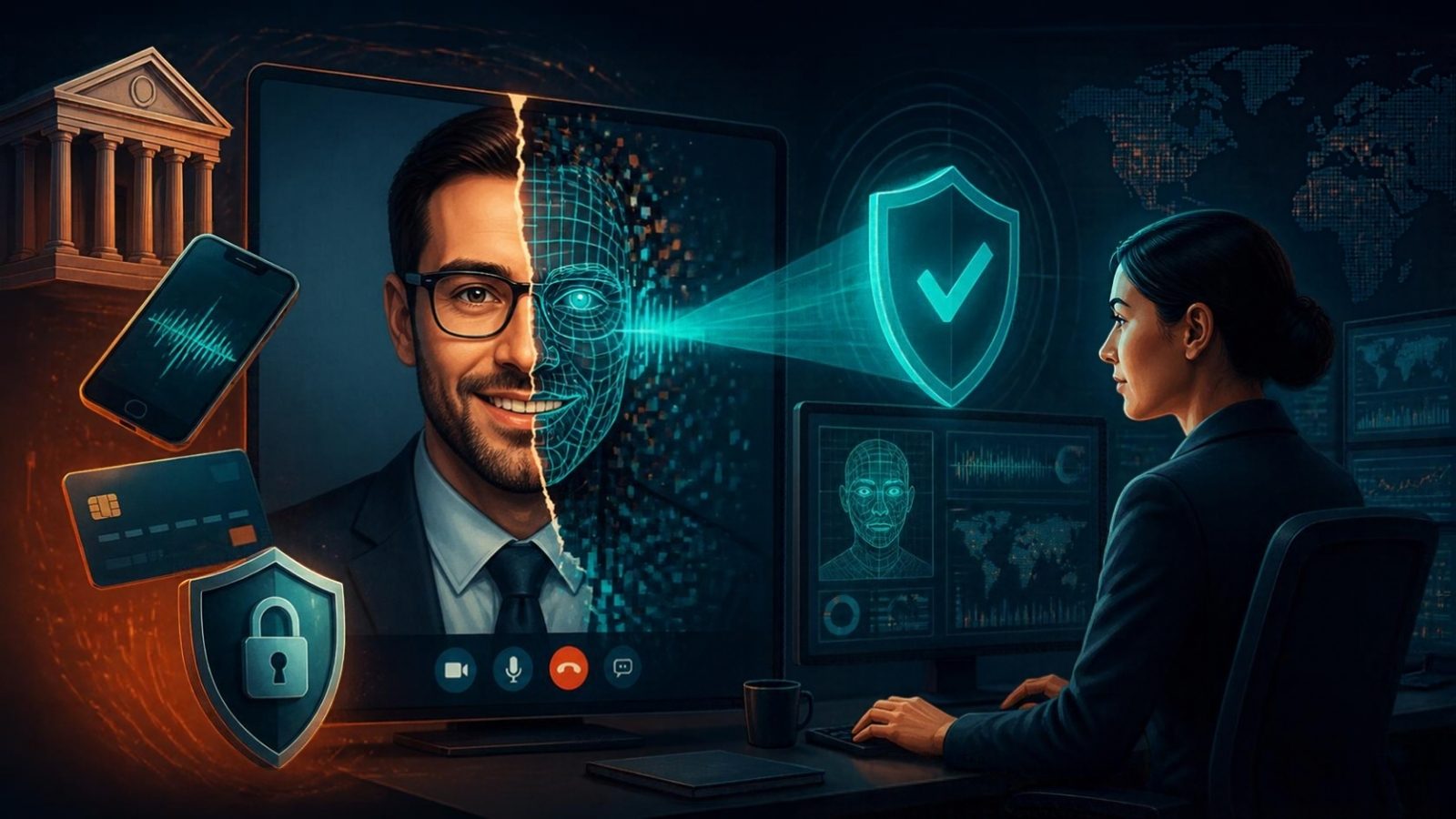
On 23 February 2026, the chairman of one of Italy's best-known private banks received a WhatsApp message. It appeared to come from the chief executive of the bank's parent group, Intesa Sanpaolo, asking for urgent help with a confidential overseas transaction.
Then came a phone call from a lawyer the chairman knew — the voice, the tone, the way he spoke all familiar. Then an email with the bank details.
Over the next three days, a series of transfers worth around €95 million left Fideuram – Intesa Sanpaolo Private Banking for accounts mainly in China and Hong Kong. The CEO had never sent the message. The lawyer had never made the call. His voice had been cloned with AI. According to reports, tens of millions of euros have still not been recovered, much of it believed to have been converted into cryptocurrency.
No system was hacked. No password was stolen. The attackers went after something far more valuable: the bank's human chain of trust.
This wasn't the first case — in 2024, an employee at engineering firm Arup in Hong Kong transferred about US$25 million after a video call in which every other "colleague", including the chief financial officer, was a deepfake. But the Fideuram case shows how far the threat has come: even a senior banker, inside a major bank, with every reason to be careful, can be fooled.
A note on perspective: my company builds technology for banks and insurers, so this is a problem I see from the inside. This post isn't about any product — it's about what every institution and customer should be doing now.
The scale of the problem in 2026
Deepfake fraud has moved from novelty to industry.
- Losses are climbing fast. Industry trackers estimate global deepfake fraud losses reached about US$3.7 billion by mid-2026, with nearly 90% of that in the past 18 months — and because most victims never report, the real figure is higher.
- Law enforcement now counts it separately. The FBI's Internet Crime Complaint Center began tracking AI-related fraud as its own category in its 2025 report, logging more than 22,000 complaints and US$893 million in losses.
- Business email scams have gone multimedia. Around 40% of business email compromise attacks now involve AI-generated voice, video or text, up from under 5% in 2023.
- The tools are cheap. Real-time face-swapping, voice cloning and "camera injection" kits are sold as fraud-as-a-service for less than US$50 a month. A convincing voice clone can be built from as little as three seconds of audio.
- Onboarding is under siege. Security firm Group-IB documented more than 8,000 attempts to inject fake biometric data into a single lender's digital onboarding process in eight months — roughly 33 attempts every day.
How AI fraud actually works
Understanding the playbook is the first step to stopping it. Six patterns dominate.
1. Executive impersonation ("CEO fraud" 2.0)
Attackers impersonate a chief executive, chairman, lawyer or supplier through a combination of messaging apps, cloned voices and sometimes live deepfake video. They create urgency and secrecy — "a confidential acquisition", "a regulatory matter" — and ask for an exceptional payment. The Fideuram and Arup cases are textbook examples.
2. Voice-clone scams against customers
A customer gets a call from "the bank's fraud team" warning that their account is compromised and asking them to move money to a "safe account". Or a parent gets a panicked call from a "child" in trouble, in a voice that sounds exactly right. The voice is cloned from social media videos, voicemail greetings or earlier calls.
3. Fake identities at onboarding
Criminals open accounts — or take out loans — using synthetic identities: AI-generated faces, forged documents and deepfake video for selfie and video-KYC checks. Increasingly, they don't even hold a fake up to a camera; they inject synthetic video directly into the verification app using virtual cameras or compromised devices.
4. Account takeover through the call centre
Where banks still rely on voice recognition or knowledge-based questions, a cloned voice plus leaked personal data can be enough to reset passwords, change phone numbers or approve transactions.
5. Fake insurance claims
Generative AI makes it easy to create or alter photos and documents: water damage that never happened, a dent added to a car, an edited invoice or medical report. Single-party claims with no witnesses — home contents, phones, minor vehicle damage — are especially exposed. In one recent industry survey, only about a third of insurers said they felt very confident they could detect deepfakes.
6. Deepfake investment scams
Deepfake videos of well-known business leaders, celebrities or even bank executives promote fake investment schemes on social media, luring customers to fraudulent platforms.
Why traditional defences are failing
- We trust voices and faces. For decades, recognising someone's voice or seeing their face on a video call was strong proof of identity. It no longer is.
- Liveness checks aren't enough. Many identity checks test whether a real person is in front of the camera. But when attackers inject synthetic video directly into the software, the camera is bypassed altogether — and standard liveness detection can't see it. Yet many organisations still rely on liveness alone.
- Payments are instant. Real-time payments are a huge benefit for customers — and for fraudsters, who can move stolen money through multiple accounts and into crypto within minutes.
- Seniority overrides process. The most dangerous phrase in any organisation is "the chairman wants this done today". Controls that apply to junior staff are often bypassed for senior ones.
- Fraud data is siloed. Banks, telecom operators and social media platforms each see part of a scam, but rarely share information fast enough to stop it.
What regulators expect
Regulators are moving, though unevenly.
- United States: FinCEN, the US Treasury's financial-crimes unit, issued an alert in November 2024 setting out red flags for deepfake fraud — such as altered identity photos, the use of third-party webcam plugins during live verification, refusals to use multi-factor authentication, and device or location data inconsistent with identity documents — and asked institutions to flag suspected cases in suspicious activity reports.
- European Union: The AI Act requires deepfakes to be clearly disclosed, with obligations to mark AI-generated content from December 2026 (more on the AI Act's timeline here). The EU's Digital Operational Resilience Act (DORA) also raises the bar on how financial institutions manage technology and fraud-related risks.
- United Kingdom: Since October 2024, payment firms have generally been required to reimburse victims of authorised push-payment scams up to £85,000 — a powerful incentive for banks to stop fraud before money leaves.
The direction is clear: regulators increasingly expect institutions to prevent AI-enabled fraud, not just report it — and in some markets, to pay when they don't.
A playbook for banks
- Never approve unusual payments through a single channel. Any request that is urgent, confidential or outside normal patterns must be verified through a separate, pre-agreed channel — calling back a known number, not the one in the message.
- No exceptions for seniority. Dual authorisation and verification rules must apply to the chairman and the CEO as much as anyone else. Make it culturally safe for staff to challenge senior requests.
- Go beyond liveness at onboarding. Combine liveness checks with injection-attack detection, device-integrity checks, document forensics and data cross-checks. Assume video can be faked.
- Retire voice-only authentication. Voice recognition on its own is no longer safe. Use layered authentication: device binding, behavioural signals and in-app confirmation.
- Add smart friction to payments. Use cooling-off periods, lower limits and step-up checks for new payees, large transfers and unusual destinations — especially transfers that could end up in crypto.
- Use AI to fight AI. Deploy behavioural analytics and real-time anomaly detection that look at how a session behaves, not just who claims to be in it.
- Share intelligence quickly. Join industry fraud-sharing networks and work with telecom operators and platforms to take down scam numbers, accounts and adverts.
- Train people with real simulations. Run deepfake voice and video drills for executives, finance teams and call-centre staff — the people attackers actually target.
- Educate customers relentlessly. Repeat the simple rules: we will never ask you to move money to a safe account, share a one-time code or install remote-access software.
- Prepare a rapid-response plan. Minutes matter. Have direct lines to correspondent banks, crypto exchanges and law enforcement to freeze funds quickly.
A playbook for insurers
- Check provenance, not just content. Inspect metadata and use content-credential standards such as C2PA where available to verify where and when an image was created.
- Capture evidence in-app. Ask claimants to take photos and videos through your own app, with live capture and location data, rather than uploading files from their gallery.
- Use AI-based image and document forensics to flag manipulated media at first notice of loss.
- Cross-check against external data — weather records, repair-shop data, previous claims and public images.
- Focus investigators where risk is highest, particularly single-party claims with no witnesses.
- Update policy wording and claims procedures to make clear that submitting AI-altered evidence is fraud, with consequences.
A playbook for companies and finance teams
- Set a firm call-back rule for every change of bank details and every unusual payment request.
- Use dual approval for payments above a threshold — and never let urgency override it.
- Agree verification code words for executives and finance teams to use in genuine emergencies.
- Treat any request for secrecy ("don't tell anyone else about this deal") as a red flag.
- Rehearse: run a simulated deepfake request and see whether your process holds.
What every customer and family should know
- Agree a family safe word that a real relative would know and a fraudster wouldn't.
- Hang up and call back on a number you already have — your bank's official number or your family member's saved contact.
- Your bank will never ask you to move money to a "safe account", share a one-time password or PIN, or install screen-sharing software.
- Urgency is the scammer's best friend. Pressure to act now is a warning sign.
- Be careful with what you share. Public videos and voice notes can be used to clone your voice; consider who can see them.
- Turn on transaction alerts and limits in your banking app.
- Don't trust a video call just because you can see a face. Ask a question only the real person could answer.
- Report quickly. The faster you report, the better the chance of freezing the money.
What governments should do
- Enable fast, legal fraud-data sharing between banks, telecom operators and online platforms.
- Hold platforms accountable for scam adverts and impersonation accounts on their services.
- Consider reimbursement rules, like the UK's, that give institutions a strong incentive to prevent fraud.
- Back content-provenance standards so that genuine media can be verified.
- Strengthen cross-border cooperation, including with cryptocurrency exchanges, to trace and freeze stolen funds.
Final thought
For centuries, banking has rested on a simple principle: know who you're dealing with. Generative AI hasn't changed that principle. It has changed what it takes to live up to it.
A familiar voice, a recognisable face or a message from the boss is no longer proof of anything. The institutions that win will be those that verify through a second channel, apply controls to everyone, use AI to detect AI, and bring their customers along with them.
Trust is still the business of banking. In 2026, protecting it takes more than a voice you recognise.
Has your organisation tested how it would respond to a deepfake request? I'd like to hear what's working — share your experience in the comments.
Sources: Reporting on the Fideuram – Intesa Sanpaolo case by AML Intelligence, FinTelegram, ITdaily and Technology.org (2026); reporting on the 2024 Arup deepfake case; FBI Internet Crime Complaint Center, 2025 Internet Crime Report; FinCEN Alert FIN-2024-Alert004 on fraud schemes involving deepfake media (November 2024); Group-IB, Weaponized AI report (January 2026); iProov threat intelligence; deepfake fraud statistics compiled by Brside, Bright Defense and StationX; SAS, Verisk and Insurance Business on AI-generated insurance fraud (2026); EU AI Act and Digital Operational Resilience Act (DORA); UK Payment Systems Regulator rules on authorised push-payment fraud reimbursement (2024); Coalition for Content Provenance and Authenticity (C2PA).