Starlink: Boom, Backlash or Both? Global Growth, African Frustrations — and Why India Still Hasn't Switched It On
Starlink doubled to 12 million users, yet Africans complain of sold-out cities and high prices, and India still hasn't launched it. Satellite phones vs Starlink, Musk's anger, and whether it fits a wider pattern of US pressure on India — from tariffs to H-1B.
By Pavan Kumar Verma · · 16 min read
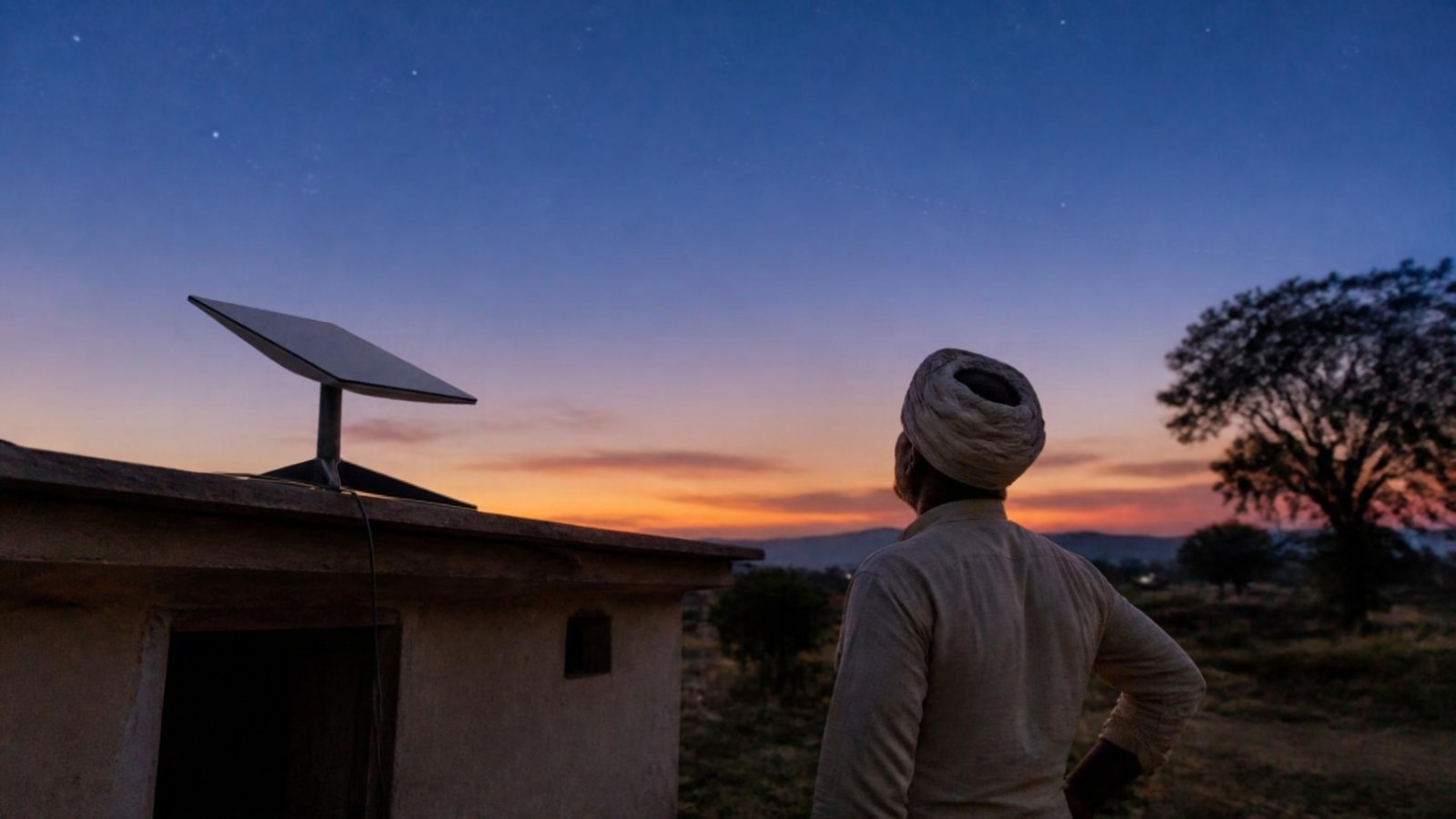
When Starlink first appeared, it felt like science fiction made real: a dish the size of a pizza box, a few minutes of setup, and fast internet anywhere on Earth — from a remote farm to a ship in the middle of the ocean. Villages without fibre, disaster zones, war zones and research stations suddenly had a lifeline.
A few years on, the conversation has changed. Some people say the excitement has faded. Others point to congestion, rising fees, national-security fears and a billionaire owner who is never far from controversy. In many African markets, users complain that Starlink has become slower and that it costs too much. And in India, Starlink still hasn't switched on — this week, Elon Musk publicly accused "oligarchs" of blocking it, and the Indian government hit back.
So let's look at the facts. Is Starlink growing or declining? What are the real concerns — including in Africa? Is India treating it the way it treats satellite phones? And is Musk angry because he's losing a fortune by not being in India?
Growth or decline? The numbers say growth — fast
If you measure by customers and revenue, Starlink is not fading. It is booming.
- Subscribers doubled in a year. SpaceX announced about 12 million Starlink customers in June 2026, up from around 6 million a year earlier. Its own filings show 10.3 million subscribers across about 155 countries at the end of March 2026.
- It's now SpaceX's main business. Starlink generated around US$11.4 billion in revenue in 2025, up 48% on the year before, and is SpaceX's main source of profit.
- It keeps expanding. Starlink says it is licensed in more than 165 countries and territories, and analysts expect around 17 million subscribers by the end of 2026.
So where does the feeling of "fading excitement" come from? It's real — but it's about what kind of growth Starlink is now having.
- Revenue per customer is falling. Average monthly revenue per subscriber has dropped from around US$99 in 2023 to about US$66 in 2026, as Starlink cuts prices and expands into poorer markets. Growth now comes from volume, not premium customers.
- Congestion is a real problem. In busy areas, new customers in some regions face one-off "demand surcharges" of hundreds of dollars — reportedly up to US$1,500 — to manage capacity, and some plans are slowed at peak times.
- Frequent plan changes frustrate users. Prices, plans and policies change often, sometimes moving in opposite directions in different markets.
- The novelty has gone. Starlink has moved from a futuristic gadget to an ordinary utility — and utilities are judged on price, reliability and service, not wonder.
In other words: the hype phase is over, but the growth isn't. That's usually what success looks like.
The real concerns about Starlink
Beyond customer complaints, governments and experts have raised deeper issues.
1. Sovereignty: one company, one owner
Starlink is critical infrastructure owned by a private company controlled by one of the world's most outspoken people. Its role in the war in Ukraine — where it has been a vital link for the military, but where decisions about coverage were reportedly shaped by Musk himself — made many governments uneasy about depending on a network they don't control.
2. National security and lawful interception
Governments need to be able to monitor communications lawfully and to cut off networks in emergencies. A satellite service that can bypass national networks raises obvious questions. There have been real incidents: in India, security forces have seized Starlink terminals used by drug smugglers in the Andaman Sea and found terminals in conflict-hit Manipur, even though Starlink isn't licensed to operate in India.
3. Regulation, ownership and local rules
Several countries ban Starlink outright — including China, Russia, Iran and North Korea. Others, such as South Africa, haven't licensed it because of local-ownership rules. Many more impose conditions on where traffic is routed and where data is stored.
4. Space safety and the night sky
Starlink has launched thousands of satellites into low Earth orbit. Astronomers worry about streaks in images and radio interference, and space-safety experts worry about collisions and debris. In 2026, SpaceX began lowering many satellites from about 550 km to around 480 km to reduce long-term debris risk after incidents involving failed satellites.
5. In Africa: "sold out", slower — and expensive
Africa shows both Starlink's promise and its limits more clearly than anywhere else.
Service quality is suffering where demand is highest.
- Kenya: Starlink has twice stopped accepting new residential customers in busy areas. The first freeze, covering Nairobi and surrounding counties, lasted about seven months from late 2024. In 2026 it froze sign-ups again in several counties, including Nairobi, Mombasa and Kiambu. Speed-test firm Ookla found that average Starlink speeds in Kenya fell by about 26% in a year, to around 35 Mbps in March 2026 — an all-time low — as subscriptions grew by nearly 60%. Users increasingly complain of slow connections in the evenings.
- Nigeria: Lagos, Abuja, Port Harcourt and other cities have been marked "sold out", with prospective customers placed on waiting lists. Ookla has flagged signs of bandwidth bottlenecks in Nigeria, Kenya, Zimbabwe and Madagascar.
The reason is physics, not marketing: each satellite beam covers a limited area and can serve only so many users at once. Starlink works brilliantly for a scattered rural population — and struggles in crowded cities, which is exactly where most paying customers are.
Cost remains a major barrier.
- Across most African markets, the hardware kit costs roughly US$200–400, and monthly residential plans run around US$30–55. In Kenya, the standard kit costs about KES 49,900 and the residential plan about KES 6,500 a month; in Nigeria, the kit costs around ₦590,000 and the residential plan around ₦57,000 a month.
- In 2024, Starlink tried to nearly double its subscription price in Nigeria, sparking a dispute with the telecoms regulator.
- For households where monthly income is a few hundred dollars or less, those prices are out of reach.
To be fair, Starlink has responded: it has cut kit prices sharply in several countries, introduced cheaper "Lite" plans, and in Kenya now offers instalment plans and kit rental from around KES 1,950 a month. And one analysis by Rest of World found that Starlink can be cheaper than many leading local internet providers in parts of Africa — a reminder of how expensive good broadband already is on the continent.
The result is a paradox: Starlink is too expensive for the rural poor it was meant to reach, and too congested in the cities where people can afford it. Its real sweet spot in Africa is businesses, NGOs, lodges, farms, schools and remote sites — not mass-market home broadband.
6. Capacity limits
Satellite capacity is finite. Each satellite can only serve so many users in a given area, which is why Starlink is strongest in sparsely populated places — and why dense countries are hard to serve at scale.
Why India stopped satellite phones — and is Starlink the same case?
To understand India's caution, you have to go back to 26 November 2008. During the Mumbai terror attacks, investigators found that the attackers used satellite phones to talk to their handlers abroad — communications that bypassed India's telecom networks and couldn't be monitored or blocked in real time.
India already restricted satellite phones under its telegraph and wireless laws, but after 26/11 enforcement became much stricter. Today, foreign satellite phones such as Thuraya and Iridium handsets cannot be used in India without government permission. Travellers have been detained for carrying them, and only authorised services that route traffic through Indian infrastructure are allowed.
The core concern is the same for Starlink: can Indian authorities lawfully monitor communications, and can they control the service during a crisis? But there is one big difference. Satellite phones were restricted because their traffic stays outside India's control. Starlink has been allowed in because it has agreed to bring its traffic under India's control.
Under India's security conditions for satellite communications:
- gateways must be located in India, and Indian traffic must not be routed through gateways abroad;
- Indian user data must not be copied, decrypted or mirrored overseas;
- operators must be able to restrict service for individuals, groups or areas during emergencies or hostilities;
- voice and data services need separate security clearances.
Starlink says it has built more than 20 gateways in India and that Indian user data will stay in India. The government is also investing around ₹900 crore in a national satellite-communications monitoring facility. So Starlink isn't being treated like a banned satellite phone — it's being asked to prove it can meet rules designed so that it never becomes one.
Where Starlink stands in India today
India's journey with Starlink has been long:
- 2021: Starlink began taking pre-orders in India without a licence; the government told it to stop, and deposits were refunded.
- 2024: Starlink and India's biggest telecom companies clashed over whether satellite spectrum should be auctioned. The government sided with Starlink's view and decided on administrative allocation, in line with international practice.
- March 2025: In a surprise twist, both Bharti Airtel and Reliance Jio signed deals to distribute Starlink equipment — even though both also back rival satellite services (Airtel through Eutelsat OneWeb, Jio through its partnership with SES).
- June 2025: Starlink received its key Department of Telecommunications licences, becoming the third licensed satellite broadband operator after OneWeb and Jio.
- October 2026: Commercial service still hasn't started. Spectrum hasn't been assigned and security clearance is pending.
Then came this week's public fight.
On 7 October 2026, Musk wrote on X that Starlink was being blocked by unnamed "oligarchs" to protect their "monopolistic chokehold" on India, calling it "a crime against the people of India". The next day he asked: "Is Ambani the real boss of India?" He offered no evidence for either claim.
India's Ministry of Communications responded within hours, calling the suggestion of unfair treatment "baseless and misconceived". It said all three licensed operators — Starlink, OneWeb and Jio — are at "broadly the same regulatory stage", that security assessments are under way for all of them, and that the clearance sits with the Ministry of Home Affairs. Communications Minister Jyotiraditya Scindia added that India does not allow monopolies in any sector.
Is Musk furious because he's losing big revenue in India?
He is clearly frustrated — his posts leave little doubt about that. But the idea that India represents an enormous, immediate pot of money doesn't stand up well to the numbers.
| Estimate | |
|---|---|
| Expected monthly price in India | ₹3,000–4,200, plus a kit costing around ₹33,000 (media reports) |
| Government cap reported for the initial rollout | About 2 million connections |
| Capacity-based analyst estimates | ~180,000 users today, rising to ~1.5–5.7 million by 2030 |
| India's whole satellite-broadband market by 2030 (Deloitte) | About US$1.9 billion a year |
| Starlink's global revenue in 2025 | About US$11.4 billion |
Even if Starlink reached the full reported cap of 2 million subscribers at around ₹3,000 a month, that would be roughly US$0.8 billion a year — significant, but less than a tenth of its current global revenue. With realistic capacity limits in the early years, the near-term figure would be far smaller.
So why does India matter so much to Musk? Because the real prize is strategic, not immediate:
- The world's largest untapped market. India has more than a billion internet subscribers, but hundreds of millions of people in rural and remote areas still lack reliable broadband.
- The future is direct-to-phone. Satellite connectivity directly to ordinary smartphones is the next frontier — and in a country like India, that could mean tens of millions of users over time.
- Enterprise, government and defence. Shipping, aviation, energy, banking in remote areas, disaster response and backup networks are high-value customers.
- Precedent. If India's rules work, they will influence other countries in the Global South.
- Competition. Every month of delay gives OneWeb, Jio–SES and Amazon's Kuiper more time to establish themselves.
The honest answer, then: Musk is losing time and strategic position in India more than he's losing a fortune today — and in a market this important, time may be worth more than money.
Is this part of a wider pattern of US pressure on India — and is Musk now playing the same game?
Many Indians see Musk's outburst not as an isolated business dispute, but as the latest episode in a broader pattern of pressure from Washington. It's worth looking at the record honestly.
The pattern so far
| When | What happened |
|---|---|
| 2025 | US officials push Starlink approvals in countries facing tariffs. The Washington Post reported that US embassies and the State Department pressed governments, including India, to clear the way for Starlink during tariff talks. The documents did not show an explicit "Starlink for tariffs" demand, but one person briefed by Indian leadership described approval as an "important lubricant" for a trade deal. |
| Jul–Aug 2025 | President Trump calls India and Russia "dead economies" and raises tariffs on Indian goods to as much as 50%, including a 25% penalty linked to India's purchases of Russian oil. White House trade adviser Peter Navarro calls the Ukraine conflict "Modi's war". |
| Sep 2025 | A US$100,000 fee on new H-1B petitions hits India hardest, since Indians receive the majority of H-1B visas (the fee has since been blocked by US courts). |
| Feb 2026 | An interim trade framework cuts tariffs on Indian goods to 18% and removes the Russian-oil penalty, after India reportedly commits to stop buying Russian crude. The US separately imposes preliminary duties of around 126% on Indian solar cells and modules. |
| Oct 2026 | The US Labor Department suspends TCS, Infosys, Wipro, HCL and Cognizant (along with Capgemini, Microsoft and Adobe) from the green card programme, with Vice President JD Vance accusing companies of gaming the system. |
| Oct 2026 | Musk accuses Indian "oligarchs" of blocking Starlink and asks: "Is Ambani the real boss of India?" |
Put side by side, the pattern is hard to miss: public, transactional pressure — tariffs, visa restrictions and sharp words, often delivered on social media and television rather than through quiet diplomacy.
Is Musk part of the same game plan?
There are real similarities. Musk's posts use the same playbook: make a dispute public, frame it in moral terms ("a crime against the people of India"), name a target, and try to shift the decision from regulators to public opinion. And there is documented evidence that the US government has actively lobbied for Starlink abroad.
But it's important not to overstate the case:
- Musk is not the US government. His relationship with the Trump administration has swung between close alliance and public falling-out. His posts are his own, and there is no public evidence that Washington endorsed his "oligarchs" claim.
- The visa crackdown isn't only about India. The green card suspension also hit Microsoft and Adobe — American companies — and is driven largely by US domestic politics over jobs and immigration.
- Trade relations have also moved forward. The February 2026 framework cut tariffs sharply, and negotiators from both sides are still working on a broader deal.
- India's Starlink process applies to everyone. The government says Starlink, OneWeb and Jio are all at the same regulatory stage, and Jio's own satellite service hasn't launched either.
A fairer reading is this: Musk is using the same pressure style that has defined US–India relations over the past two years — loud, public and transactional — whether or not it's coordinated. That style can work in the short term. But it also risks the opposite effect: in a democracy as large and proud as India, being seen to bend to public pressure from a foreign billionaire carries a heavy political cost.
How India should respond
India's best response is neither to give in nor to dig in. It is to make its process so clear, consistent and transparent that pressure has nothing to push against:
- publish clear timelines for security clearance and spectrum assignment;
- apply exactly the same tests to Indian and foreign operators — and show that it does;
- keep strategic decisions on telecom, data and national security separate from trade bargaining;
- and keep negotiating firmly on trade and visas through formal channels, not social media.
Rules-based clarity is India's strongest defence against pressure — from any government, or any billionaire.
What India should get right
India's caution is understandable, but delay has costs too. A few principles would help:
- Clear, published timelines for security clearance and spectrum assignment, applied equally to every operator.
- Equal rules for all, including Indian companies — which the government says is already the case. Transparency would help prove it.
- Strong lawful-interception and data-localisation safeguards, without making compliance so slow that rural users lose out.
- Affordable access for the people who need it most — remote villages, islands, border areas, disaster zones — perhaps through public programmes and shared community terminals.
- Space sustainability commitments as a condition of access, so that growth in orbit doesn't come at the cost of safety.
Final thought
Starlink's story isn't one of boom and bust. It's the story of a technology moving from wonder to utility — with all the price wars, congestion, regulation and politics that come with being infrastructure. Africa shows the lesson most clearly: satellites can reach anywhere, but they can't yet serve everyone, everywhere, at a price everyone can afford.
India's position isn't the same as its old ban on satellite phones, but it comes from the same place: a country that learned in 2008 what can happen when communications slip beyond its control. The test now is whether India can apply those lessons fairly and quickly enough that its most remote citizens — and its digital economy — don't pay the price of waiting.
As for Musk, the fight is less about this year's revenue than about who gets to connect the next billion people — and, increasingly, about whether pressure from Washington and Silicon Valley can shape India's choices. India's answer should be calm, consistent rules that apply to everyone. That's a fight worth watching.
What do you think — is India right to be cautious, or is the delay costing the country more than it protects? And is Musk's outburst part of a wider pattern of US pressure? Share your view in the comments.
Sources: SpaceX announcements and filings on Starlink subscribers and revenue, as reported by Stocktwits, Sacra and Midgard Finance; analysis by Quilty Space; SatelliteInternet.com, DishyTech and other reviews on congestion surcharges and plan changes; The Register and Daily Galaxy on Starlink lowering satellite orbits (2026); Space.com on astronomy concerns; Starlink News on country approvals and bans (2026); Business Daily, TechTrendsKE, Dawan Africa and AllAfrica on Starlink's sign-up freezes, congestion and Ookla speed data in Kenya (2024–2026); Ecofin Agency on Nigeria's sold-out cities and waiting lists; Connecting Africa on Starlink's Nigerian price increase and Kenyan kit rental; TechCabal, Tech.Africa and Rest of World on Starlink pricing and affordability in Africa; reporting on India's satellite-phone restrictions and their link to the 2008 Mumbai attacks (The420.in and maritime and customs guidance); Ministry of Communications statements on satcom security conditions; ThePrint and Outlook on Starlink's gateways and pending clearances; Tribune on the national satcom monitoring facility; TechCrunch (October 2026) on Musk's posts and the government's response; Business Today, Business Standard and Deccan Chronicle on the Ministry's rebuttal; Scroll and Reuters reporting on the Airtel and Jio distribution deals (2025); TechCrunch (2024) on the spectrum-allocation decision; Business Standard and Inc42 on expected Indian pricing; Jefferies, IIFL Research and Deloitte estimates of India's satellite-broadband market; The Washington Post (2025) on US lobbying for Starlink approvals during tariff talks, as reported by The Wire and others; The Tribune on Peter Navarro's "Modi's war" remarks and President Trump's "dead economy" comment (2025); the White House US–India Joint Statement (February 2026) and Morgan Lewis and India Briefing on the interim trade framework; reporting on US countervailing duties on Indian solar products (2026); reporting on the H-1B fee and the October 2026 green card (PERM) suspension.