The Great Telecom Squeeze: Why Mobile Markets Are Consolidating Everywhere — and What India's Journey From a Dozen Operators to Three Teaches the World
India went from a dozen mobile operators to three private players and BSNL. A look at telecom consolidation in the top 10 markets — China, the US, Indonesia, Brazil, the UK, Spain, Australia, Malaysia and Thailand — why it's happening, who wins and loses, and how satellites could bring competition back.
By Pavan Kumar Verma · · 12 min read
Fifteen years ago, an Indian mobile customer could choose between a dozen or more operators — Airtel, Vodafone, Idea, Reliance Communications, Tata Docomo, Aircel, Uninor, Videocon, MTS, BSNL, MTNL and others. Calls cost less than a rupee a minute, and every few months a new brand promised something cheaper.
Today, India has three private operators and one state-owned one. And India isn't unusual. From the United States to Europe and Southeast Asia, telecom markets are shrinking to a handful of large players.
This post looks at why telecom is consolidating almost everywhere, what India's journey from a dozen operators to three teaches the world, and what comes next — including an unexpected new challenger arriving from space.
Why telecom keeps consolidating
The economics of telecom push relentlessly towards scale:
- Networks are enormously expensive. Each new generation — 4G, then 5G, soon 6G — requires tens of billions of dollars in spectrum, towers, fibre and equipment.
- Spectrum costs are front-loaded. Operators often pay huge sums at auction years before they earn a return.
- Prices keep falling. Fierce competition and the shift from calls and SMS to data have pushed average revenue per user (ARPU) down in many markets.
- Customers want everything. Mobile, home broadband, fibre, enterprise services, cloud and content increasingly come as a bundle — which favours large, integrated operators.
- Scale lowers costs. Merging two networks lets operators share sites, spectrum and IT systems, cutting costs while improving coverage.
The result is a familiar pattern: a period of intense competition and price wars, followed by exits and mergers, until three (sometimes two) strong players remain.
India: from a dozen operators to three
India is the most dramatic example of consolidation anywhere in the world.
| Period | What happened |
|---|---|
| 2008–2012 | Licences issued to many new operators; India has a dozen or more mobile brands in most regions; prices fall to among the lowest in the world |
| 2012 | The Supreme Court cancels 122 licences issued in 2008, forcing several new entrants out |
| 2016 | Reliance Jio launches with free voice and very cheap data, triggering a brutal price war |
| 2017–2019 | Tata Docomo's mobile business is folded into Airtel; Aircel and Reliance Communications collapse into insolvency; Telenor (Uninor) sells to Airtel |
| 2018 | Vodafone India and Idea Cellular merge to form Vodafone Idea (Vi) |
| 2019–2021 | The Supreme Court's ruling on adjusted gross revenue (AGR) dues leaves operators — especially Vi — owing huge sums to the government |
| 2021–2026 | The government converts dues into equity to keep Vi alive; its stake rises to about 49%. Tariffs rise in steps, including a broad hike in 2024 |
Today the market looks like this (TRAI data, June 2026):
| Operator | Wireless subscribers | Market share |
|---|---|---|
| Reliance Jio | ~504 million | 39.3% |
| Bharti Airtel | ~487 million | 38.0% |
| Vodafone Idea | ~199 million | 15.5% |
| BSNL (state-owned) | ~93 million | 7.3% |
Two players — Jio and Airtel — now hold more than three-quarters of the market, and Airtel is steadily closing the gap with Jio. Vi survives largely because the government has chosen to keep it alive, explicitly to avoid a duopoly.
What India's consolidation delivered
- The world's cheapest mobile data for years, putting hundreds of millions of people online for the first time.
- Huge investment in 4G and then one of the fastest 5G rollouts in the world, led by Jio and Airtel.
- Two financially strong operators able to invest in fibre, enterprise services, satellites and data centres.
What it cost
- Fewer choices for consumers and businesses.
- Rising prices as operators push tariffs up to repair their balance sheets.
- A fragile third player. Vi's survival depends on government support, while BSNL remains a small state-owned operator.
- Concentration risk. If Vi weakens further, India could drift towards a two-player market — something regulators everywhere try to avoid.
The United States: three giants, and a fourth that faded
The US moved from four national mobile operators to three when T-Mobile merged with Sprint in 2020. Dish Network (later part of EchoStar, with its Boost Mobile brand) was meant to become the new fourth network. That plan has since largely unravelled.
Recent moves show how far consolidation has gone:
- T-Mobile bought UScellular's wireless business for about US$4.4 billion in 2025, while AT&T and Verizon bought much of the rest of its spectrum.
- EchoStar sold around US$40 billion of spectrum — roughly US$23 billion to AT&T and about US$17 billion to SpaceX — and Boost is shifting to a hybrid network model rather than relying entirely on its own radio network.
- Fibre is the new battleground. Verizon completed its acquisition of Frontier in January 2026, and AT&T bought Lumen's consumer fibre business for US$5.75 billion, as mobile operators race to own home broadband too.
Europe: too many operators, and a new push for scale
Europe is the opposite case. With 27 national markets, each with its own operators and regulators, the region is far more fragmented than the US or China. European leaders — including former Italian prime minister Mario Draghi in his 2024 competitiveness report — have argued that this fragmentation leaves operators too small to invest at the scale Europe needs.
The direction is changing:
- UK: Regulators approved the Vodafone–Three merger at the end of 2024, and it completed in 2025, reducing the market from four mobile networks to three, in exchange for binding commitments to invest in network upgrades. Many in Europe now see it as a blueprint.
- Spain: Orange and MásMóvil combined to form MasOrange in 2024.
- Italy and France are widely expected to see further deals.
- New EU rules: In January 2026, the European Commission proposed the Digital Networks Act, which would create a single EU framework with a "single passport" for operators. Draft merger guidelines published in April 2026 give more weight to scale and investment when assessing telecom deals.
Cross-border, pan-European mergers remain difficult — but domestic "four-to-three" deals are becoming more acceptable.
Asia: the four-to-three wave
Southeast Asia has seen some of the most significant recent consolidation:
- Indonesia: Indosat Ooredoo and Hutchison 3 merged in 2022. Then, in April 2025, XL Axiata and Smartfren completed a US$6.5 billion merger to form XLSmart — leaving Indonesia with three main operators. XLSmart reported revenue growth of 23% in its first full year.
- Malaysia: Celcom and Digi merged in 2022 to form CelcomDigi.
- Thailand: The True–DTAC merger in 2023 left Thailand with what is effectively a two-player market, with the combined company holding around 53% of subscribers against AIS's 45% — raising serious competition concerns.
- Singapore: A planned sale of M1 to SIMBA Telecom collapsed in 2026, but by late September M1's owner Keppel and rival StarHub had confirmed talks.
Africa: consolidation of a different kind
Africa's story is different. Many African markets are already dominated by one or two large operators — Safaricom in Kenya, MTN and Airtel in Nigeria — so the focus is less on operator mergers and more on:
- Selling towers and infrastructure to specialist companies to free up capital;
- Investment in fibre, subsea cables and data centres, often from development finance institutions and Gulf investors;
- Ownership changes at the group level, where shifts at companies such as Vodafone can ripple through to subsidiaries like Vodacom and Safaricom.
For Africa, the challenge is often the opposite of Europe's: not too many operators, but too little competition and investment in some markets.
Top 10 countries: telecom consolidation at a glance
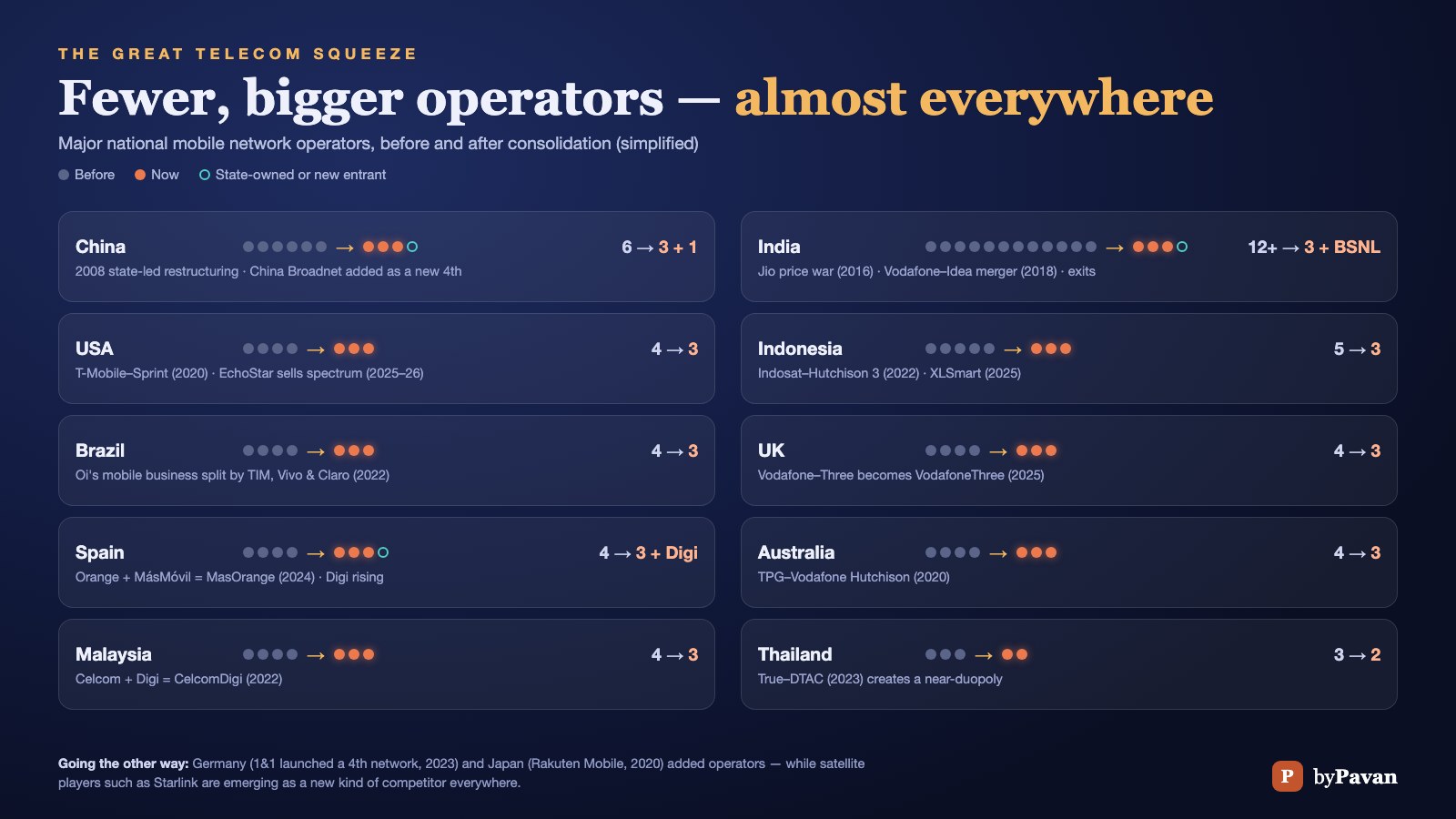
Here's how consolidation has reshaped ten of the world's most important mobile markets (major national mobile network operators, simplified):
| Country | Operators: then → now | Key consolidation moves | Main operators today |
|---|---|---|---|
| China | 6 → 3 (+1 new) | State-led restructuring in 2008 merged six operators into three full-service carriers; China Broadnet later licensed as a fourth (about 44 million 5G users) | China Mobile, China Telecom, China Unicom, China Broadnet |
| India | 12+ → 3 private + BSNL | 2012 licence cancellations; Jio's 2016 price war; Vodafone–Idea merger (2018); Telenor and Tata Docomo absorbed by Airtel; Aircel and RCom insolvencies | Jio, Airtel, Vodafone Idea, BSNL |
| United States | 4 → 3 | T-Mobile–Sprint (2020); T-Mobile buys UScellular (2025); EchoStar sells ~$40bn of spectrum to AT&T and SpaceX (2025–26) | Verizon, AT&T, T-Mobile |
| Indonesia | 5 → 3 | Indosat Ooredoo–Hutchison 3 (2022); XL Axiata–Smartfren form XLSmart (2025) | Telkomsel, Indosat Ooredoo Hutchison, XLSmart |
| Brazil | 4 → 3 | Oi's mobile business split between TIM, Vivo and Claro (2022) | Vivo, Claro, TIM |
| United Kingdom | 4 → 3 | Vodafone and Three merge into VodafoneThree (2025), with network-investment commitments | EE (BT), VodafoneThree, Virgin Media O2 |
| Spain | 4 → 3 (+ Digi) | Orange and MásMóvil combine as MasOrange (2024); Digi grows into a fourth operator with about 12–13% of mobile lines | Movistar, MasOrange, Vodafone Spain, Digi |
| Australia | 4 → 3 | Vodafone Hutchison Australia and TPG merge (2020) after defeating a competition-regulator challenge in court | Telstra, Optus, TPG Telecom |
| Malaysia | 4 → 3 | Celcom and Digi merge into CelcomDigi (2022) | Maxis, CelcomDigi, U Mobile |
| Thailand | 3 → 2 | True and DTAC merge (2023), leaving a near-duopoly of about 53% vs 45% | AIS, True |
Going the other way. Not every market is consolidating. Germany went from four networks to three after Telefónica bought E-Plus in 2014, then back to four when 1&1 launched its own network in 2023. Japan gained a fourth operator when Rakuten Mobile launched in 2020. Both show that regulators can — and sometimes do — choose to bring in new competitors rather than allow further mergers.
The pattern is clear: most big markets are settling at three strong mobile operators. Markets that drop to two, like Thailand, raise real concerns about prices and choice — while new entrants, from fourth operators like Digi and Rakuten to satellite networks like Starlink, are the main forces pushing the other way.
The new twist: competition from space
Just as terrestrial markets settle into three-player structures, a new kind of competitor is arriving — satellites.
- SpaceX is becoming a spectrum owner. After buying around US$17 billion of spectrum from EchoStar, SpaceX agreed in October 2026 to buy additional low-band 800 MHz spectrum to fill gaps in its planned Starlink Mobile service. The announcement knocked the share prices of AT&T, Verizon and T-Mobile.
- The incumbents are joining forces. Days earlier, on 2 October 2026, AT&T, T-Mobile and Verizon formally launched a joint venture to pool resources for satellite direct-to-device coverage — widely seen as a response to SpaceX.
- India is watching closely. Starlink, Jio and Eutelsat OneWeb (backed by Airtel's parent group) are all licensed and awaiting final clearances, and Jio plans its own constellation of around 1,600 satellites (more on India's satellite race here).
In many markets, satellite operators may effectively become the "fourth operator" that consolidation removed — at least for rural coverage, emergencies and connecting devices beyond the reach of towers.
Consolidation: good or bad?
The honest answer is: both — and it depends on what regulators demand in return.
| Benefits | Risks |
|---|---|
| Stronger balance sheets and more investment in 5G and fibre | Higher prices for consumers and businesses |
| Better coverage and network quality after merging sites and spectrum | Less choice and slower innovation |
| Lower costs through shared infrastructure | Risk of duopolies, as in Thailand |
| More resilient networks during crises | Weaker bargaining power for enterprises and smaller players |
The best outcomes tend to come where regulators approve mergers with conditions — binding investment commitments, coverage obligations, price protections or remedies that help smaller competitors — as the UK did with Vodafone–Three.
Lessons for India
- Keep at least three strong private operators. A healthy third player matters — the government's support for Vi reflects this, but long-term viability will require a credible business plan and fresh private capital, not just state support.
- Make BSNL useful. A state operator can play a valuable role in rural coverage, strategic networks and as a wholesale provider — if it's run efficiently.
- Price spectrum for investment, not just revenue. Lower upfront costs and smarter payment terms leave operators more to invest in networks.
- Encourage infrastructure sharing, especially towers, fibre and rural networks, to cut costs without reducing competition at the retail level.
- Let satellites compete — fairly. Satellite operators can add genuine competition in rural and remote areas, provided they meet the same security and fairness standards.
- Protect consumers as tariffs rise. Transparency, affordable entry-level plans and strong service-quality rules matter more in a concentrated market.
Lessons for other markets
- Don't wait for operators to fail. India's consolidation happened through price wars, insolvencies and court rulings. Planned consolidation, with clear conditions, is less disruptive.
- Set merger conditions that protect investment and consumers, following the UK's approach.
- Watch for duopolies. Three strong operators are usually healthier than two.
- Use new technologies — satellites, fixed wireless, open networks — to keep markets contestable.
Final thought
Telecom has always been a scale business, and consolidation was inevitable after the boom years of too many operators chasing too few profits. India's journey from a dozen operators to three shows both sides of the story: the price war that connected a nation, and the concentration that followed.
The next chapter will be shaped by regulators, by whether third players like Vi can stand on their own — and by satellites, which may bring back some of the competition that mergers took away.
Do you think fewer, stronger operators are good for consumers — or is the industry becoming too concentrated? Share your view in the comments.
Sources: TRAI telecom subscription data for 2026, as reported by TelecomTalk, Tele.net and India TV News; Business Standard, Upstox and TelecomTalk on Vodafone Idea's AGR relief, government stake and tariffs; reporting on India's telecom history including the 2012 Supreme Court licence cancellation, Reliance Jio's 2016 launch and the 2018 Vodafone–Idea merger; CNBC, Axios and PwC on US deals including SpaceX's spectrum purchases, EchoStar's spectrum sales, Verizon–Frontier, AT&T–Lumen and T-Mobile–UScellular; Light Reading, SatNews, Via Satellite and AT&T on the AT&T–T-Mobile–Verizon satellite joint venture (October 2026); European Commission, Jones Day, CMS and the European Parliament on the Digital Networks Act; ING Think on European telecom M&A; Bratby Law on EU merger guidelines; Nikkei Asia, Jakarta Globe and Wikipedia on the XLSmart merger; TeleGeography M&A Monthly (2026) on Singapore and Macau deals; TeleInfoToday on Indonesia and Thailand; MarketScreener, TIM and Light Reading on the sale of Oi's mobile business (2022); Telecompaper, Norton Rose Fulbright and Telecoms.com on the TPG–Vodafone Hutchison Australia merger (2020); Telecompaper, Telecoms.com and DCD on Digi Spain; Light Reading and Marbridge Consulting on China Broadnet; China Economic Review and Lexology on China's 2008 telecom restructuring; Streamlinefeed and TeleGeography on African telecom investment; the Draghi report on European competitiveness (2024).