Starlink vs Jio: Why Elon Musk Is Targeting Ambani — Not Mittal — and Who Else Is Racing for India's Skies
Musk asked "Is Ambani the real boss of India?" but spared Airtel's Sunil Mittal. Jio's planned 1,600-satellite constellation, Airtel's OneWeb stake, Ananth Technologies' GEO satellite, and what the satellite race means for Indian consumers.
By Pavan Kumar Verma · · 8 min read
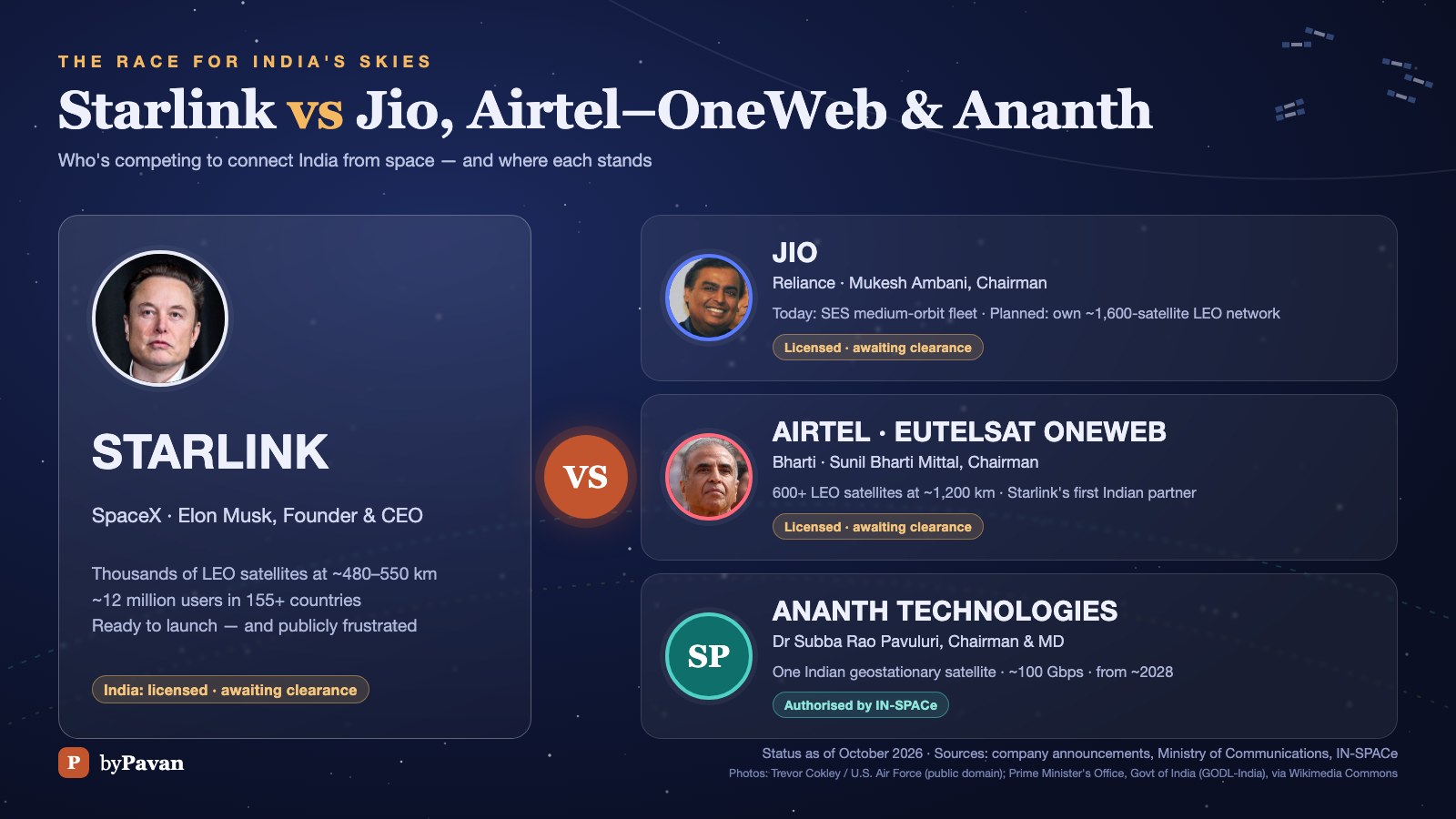
This week, Elon Musk did something unusual even by his standards. After accusing unnamed "oligarchs" of blocking Starlink's launch in India, he asked on X: "Is Ambani the real boss of India?"
He didn't name Sunil Bharti Mittal, whose Airtel is India's second-largest telecom company and whose group is the biggest shareholder in Starlink's rival Eutelsat OneWeb. He didn't name anyone else. Only Mukesh Ambani, chairman of Reliance and owner of Jio.
Why Ambani — and not Mittal? Is it because Jio is building its own satellite network? And what about Indian newcomers like Ananth Technologies — are they part of the story too?
(For the bigger picture on Starlink's global growth, its problems in Africa, and India's security concerns, see my earlier post on Starlink.)
The race for India's skies: who's who
India's satellite internet market has more players than most people realise — and they're using very different technologies.
| Player | Backed by | Orbit and approach | Status in India (Oct 2026) |
|---|---|---|---|
| Starlink | SpaceX (Elon Musk) | Thousands of low Earth orbit (LEO) satellites at roughly 480–550 km | Licensed; awaiting spectrum and security clearance |
| Jio Satellite Communications | Reliance (Mukesh Ambani) | Today: SES's medium Earth orbit (MEO) fleet for JioSpaceFiber. Planned: its own constellation of ~1,600 LEO satellites | Licensed; awaiting spectrum and security clearance |
| Eutelsat OneWeb | Eutelsat, with the Bharti group as its largest shareholder (Sunil Bharti Mittal) | Around 600+ LEO satellites at about 1,200 km | Licensed; awaiting spectrum and security clearance |
| Amazon Kuiper | Amazon | LEO constellation, still being deployed | Awaiting licence |
| Ananth Technologies | Indian private company, Hyderabad | One large geostationary (GEO) satellite at 89°E, about 36,000 km up | Authorised by IN-SPACe in 2025; service targeted from around 2028 |
The government says Starlink, Jio and OneWeb are all at "broadly the same regulatory stage", with security assessments under way for all three. None has launched commercial satellite broadband yet.
Why Musk is targeting Ambani
Musk hasn't explained his reasoning, so what follows is analysis, not fact. But five factors stand out.
1. Jio is building a direct, like-for-like rival to Starlink
This is the biggest reason. Jio isn't just reselling someone else's satellites — it plans to build its own LEO constellation of around 1,600–1,650 satellites at about 650 km, supported by more than 20 ground stations in India. Reports put the cost at US$10–15 billion, with a test flight targeted around September 2027, about 400–450 satellites by 2030, and the full network by 2035.
India's space regulator, IN-SPACe, reportedly found the plan "technically sound" and comparable to systems like Starlink. Reports also say Jio's planned network targets around 5 terabits per second of capacity over India — far more than the capacity Starlink has been approved for in the country.
In other words, Jio is planning exactly what Starlink is: a homegrown, Indian-controlled version of the same technology. Every month Starlink waits is a month Jio gets closer to launching its own.
2. The timing
Jio showcased its satellite plans at India Mobile Congress 2026 — the same week as Musk's posts. Akash Ambani, chairman of Reliance Jio, told the audience that Jio is building indigenous satellite technology and promised that "every Indian home will have a broadband connection". Asked about Musk's "oligarchs" claim, he said: "No comments."
3. The history: Jio led the fight over spectrum
In 2024, Jio was the loudest voice arguing that satellite spectrum should be auctioned — as mobile spectrum is — rather than allocated administratively. Starlink argued the opposite, and the government ultimately sided with administrative allocation, in line with international practice. That public clash made Jio Starlink's most visible opponent in India.
4. Market power makes the "monopoly" message work
Jio is India's largest mobile operator, built on the low-price disruption that reshaped Indian telecom after 2016. Mukesh Ambani is one of Asia's richest people and among India's most prominent industrialists. Framing the story as "a powerful tycoon protecting his monopoly" is a far more compelling message — especially on social media — than "a regulator is taking its time".
5. Ambani is the bigger symbol
Musk's posts were aimed as much at public opinion as at regulators. Naming the country's best-known business figure turns a dry licensing delay into a headline-grabbing personal rivalry.
Why not Sunil Bharti Mittal?
On paper, Mittal has at least as much reason to be seen as a rival. His group is the largest shareholder in Eutelsat OneWeb — a direct Starlink competitor — and he is co-chair of Eutelsat. Airtel has also argued that satellite companies serving cities should buy spectrum "like everybody else". So why isn't Mittal in Musk's firing line?
Again, this is analysis, but several reasons are likely:
- Airtel was Starlink's first Indian partner. Airtel signed its deal to distribute Starlink equipment and services in March 2025 — a day before Jio did. Attacking your first and closest partner would make little sense.
- OneWeb's model is different. OneWeb has focused largely on businesses, governments, telecom backhaul and remote sites, rather than competing head-on for millions of Indian homes. And Airtel isn't building a new mass-market constellation of its own; OneWeb already exists.
- Mittal kept his tone diplomatic. Rather than respond in kind, Mittal simply pointed out that "OneWeb is waiting too" — that his own company is also awaiting approval. That undercuts Musk's claim of special treatment without escalating the fight.
- Jio is the one with the most to gain from delay. A brand-new constellation needs time. Airtel's satellite partner is already in orbit; Jio's isn't.
In short: Mittal is a competitor Musk works with. Ambani is a competitor Musk is racing against.
The irony: partners and rivals at the same time
There's a twist that makes this rivalry unusual. Jio is also a Starlink distribution partner. In March 2025, Jio agreed to sell Starlink equipment through its stores and online channels, once Starlink is approved.
So Musk is accusing a company of blocking a service that the same company has signed up to sell. Business strategists call this "coopetition": cooperating where it helps and competing where it matters. For Jio, distributing Starlink in the short term while building its own network for the long term is a way to win either way.
Is Ananth Technologies part of this?
Not really — at least not as a reason for Musk's anger.
Ananth Technologies, a Hyderabad-based company that has supplied components for dozens of Indian launch vehicles and satellites, became in 2025 the first private Indian company authorised by IN-SPACe to offer satellite broadband using an Indian orbital slot. Its plan:
- one large geostationary satellite at 89°E, weighing around 3–4 tonnes;
- around 100 Gbps of capacity over the Indian mainland and maritime zones;
- an initial investment of about ₹3,000 crore;
- services targeted from around 2028 (some sources say 2029).
That's important for India — it builds sovereign capacity and shows that private Indian companies can now compete in space. But it's a very different product from Starlink. Geostationary satellites sit about 36,000 km above Earth, which means higher latency and far less total capacity than a large LEO constellation. Ananth is likely to focus on enterprise, government, maritime and backhaul users rather than millions of homes.
So Ananth isn't a direct threat to Starlink's consumer business — and there's no sign Musk sees it as one. The real rivalry is LEO versus LEO: Starlink versus Jio's planned constellation.
What's really holding everyone back
Behind the headlines, the actual bottlenecks are the same for all three licensed operators:
- Security clearance, now with the Ministry of Home Affairs, covering lawful interception, data localisation and the ability to restrict service in emergencies;
- Spectrum assignment, which only follows security clearance;
- Final pricing and fees, based on recommendations from the telecom regulator, TRAI.
If the government is right that all three are at the same stage, then the "Ambani is blocking Starlink" claim is hard to sustain. But perceptions matter — and the best way for India to answer them is to publish clear timelines and apply them visibly and equally.
What it means for Indian consumers
Competition is good news — if it arrives.
- More choice, lower prices. With Starlink, Jio, OneWeb and potentially Kuiper competing, prices should fall faster than if any single player dominated.
- Better rural coverage. Satellites are most valuable where fibre and mobile towers don't reach: remote villages, mountains, islands, border areas and disaster zones.
- Satellites complement, not replace, fibre and 5G. In dense cities, ground networks will remain faster and cheaper. The winners will be those who combine satellite, mobile and fibre into one seamless service — exactly what Jio and Airtel are positioning to do.
- Sovereignty matters. An Indian-built constellation, alongside foreign ones, gives the country more control over a critical piece of infrastructure.
Final thought
Musk's attack on Ambani isn't really about who is "the real boss of India". It's about time. Starlink is ready to launch and frustrated that it can't. Jio is building a rival and benefits from every month that passes. Airtel sits comfortably in the middle — partnering with Starlink while backing OneWeb.
For India, the right outcome isn't to choose between Musk and Ambani. It's to clear every operator on clear, equal and published terms — and then let them compete to connect the hundreds of millions of Indians who still lack reliable broadband.
Who do you think will win India's satellite race — Starlink, Jio, OneWeb, or someone else? Share your view in the comments.
Sources: TechCrunch, BBC (via Yahoo), Business Today, IBTimes and KuCoin News on Musk's posts and responses (October 2026); Business Today, TelecomTalk and NewsBytes on Akash Ambani's remarks at India Mobile Congress 2026; Free Press Journal, Kotak Neo, Sahi, Outlook Business and BeInCrypto on Jio's planned LEO constellation, cost and timeline; SES announcements and TechAfrica News on the O3b mPOWER constellation and Jio's JioSpaceFiber service; HDFC Sky, Inkl and Invezz on Sunil Bharti Mittal's response and Bharti's role in Eutelsat OneWeb; Whalesbook on Airtel's position on satellite spectrum auctions; Business Standard, Tele.net, Indian Space Technology and Wikipedia on Ananth Technologies' IN-SPACe authorisation; TechCrunch (2024) on the spectrum allocation decision; Tribune, Gulf News and Malay Mail on the Airtel and Jio distribution deals with SpaceX (March 2025); Ministry of Communications statement (8 October 2026).
Cover photos: Elon Musk by Trevor Cokley, U.S. Air Force (public domain); Mukesh Ambani and Sunil Bharti Mittal by the Prime Minister's Office, Government of India (Government Open Data License – India); all via Wikimedia Commons.